

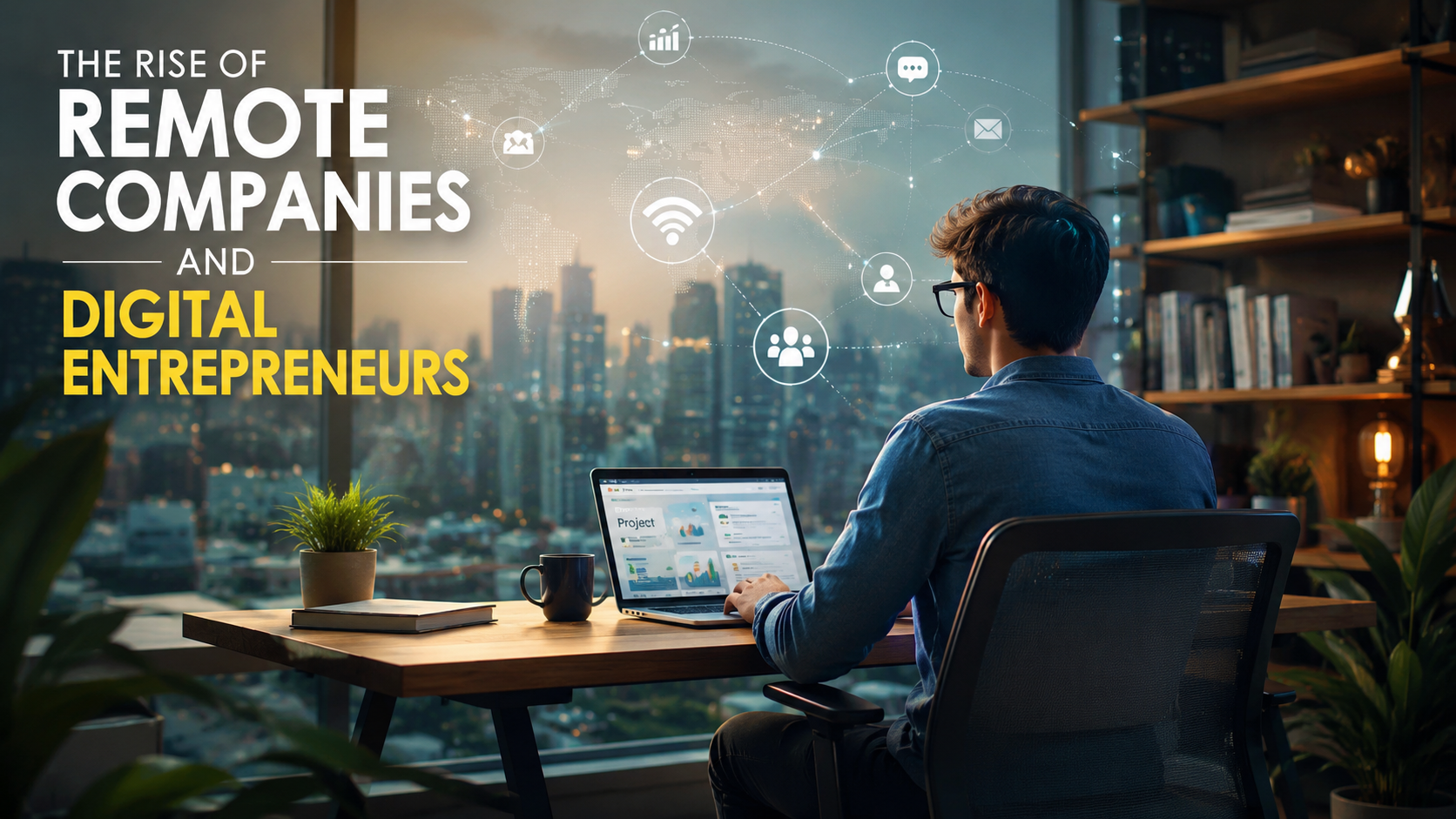
A decade ago, the idea of running a seven-figure company from a laptop in a coffee shop sounded like a fantasy reserved for tech outliers. Today, it is simply Tuesday for millions of people. The rise of remote companies and digital entrepreneurs has quietly rewritten the rules of business, turning bedrooms, co-working spaces, and beachside cafés into fully functioning headquarters.
This shift did not happen overnight, and it was not caused by a single event. A mix of better technology, changing employee expectations, and a global pandemic that forced everyone’s hand combined to create a new normal.
What used to be a niche lifestyle choice is now a mainstream business strategy, and understanding why can help anyone, whether you are an employee, freelancer, or aspiring founder, make sense of where work is heading.
Why Remote Companies Are No Longer the Exception
For a long time, remote work was treated as a perk rather than a serious business model. Companies allowed it grudgingly, usually for a handful of trusted employees or specific roles like customer support. That mindset has almost completely flipped.
Today, entire organizations operate without a central office. Teams span continents, time zones, and cultures, yet somehow ship products, close sales, and serve customers just as effectively, sometimes more effectively, than their office-bound counterparts. The rise of remote companies is no longer an experiment; it is a proven, scalable way to build a business.
The Technology That Made It Possible
None of this would be feasible without the tools that quietly power remote operations behind the scenes. Cloud-based project management platforms, instant messaging apps, video conferencing software, and cloud storage solutions have erased the practical barriers that once made distributed teams difficult to manage. A designer in Lisbon can hand off a project file to a developer in Manila within seconds, while a manager in Toronto reviews progress on a shared dashboard in real time.
These tools did not just replace the office; in many ways, they improved on it. Written communication forces clarity. Asynchronous workflows respect different schedules and time zones. Documentation becomes a habit rather than an afterthought. The result is often a more organized, transparent way of working than traditional office culture ever managed to achieve.
The Pandemic Accelerated an Existing Trend
It is impossible to talk about remote companies without mentioning the pandemic, but it is worth being precise about its role. Remote work was already growing steadily before 2020. What the pandemic did was compress years of gradual adoption into a matter of months, forcing skeptical executives to test theories they had resisted for years.
Many discovered, somewhat to their surprise, that productivity did not collapse. In several cases, it improved. Once that psychological barrier was broken, there was no convincing reason to force everyone back into a fixed location, especially when talented candidates increasingly refused to consider jobs that required a commute.
The Parallel Rise of Digital Entrepreneurs
While remote companies were reshaping traditional employment, a separate but related movement was gaining momentum: digital entrepreneurship. These are individuals who build businesses entirely online, often without ever hiring a traditional employee or renting a physical space.
Digital entrepreneurs come in many forms. Some run e-commerce stores selling physical or digital products. Others build software-as-a-service tools, offer freelance consulting, create online courses, or monetize content through platforms like YouTube and Substack. What unites them is a shared belief that a laptop and an internet connection are enough to build something meaningful.
Lower Barriers to Entry Than Ever Before
Starting a business used to require significant capital: a storefront, inventory, staff, and overhead costs that made failure expensive and recovery slow. Digital entrepreneurship flips that equation. Website builders, payment processors, and marketing platforms have dramatically lowered the cost of testing an idea.
This does not mean success is easy or guaranteed. It simply means the cost of trying has dropped enough that more people are willing to take the leap. A person with a compelling idea and a modest budget can launch a business in a weekend, something that was almost unthinkable a generation ago.
The Appeal of Freedom and Flexibility
Beyond economics, there is a cultural shift at play. Many digital entrepreneurs are not chasing wealth alone; they are chasing autonomy. The ability to set their own hours, choose their own clients, and design a lifestyle around their work, rather than the other way around, is often the real motivation.
This desire for freedom has fueled the popularity of concepts like the four-hour workweek, location independence, and the broader digital nomad movement. While the reality of running a business rarely matches the glossy version seen on social media, the underlying appeal of controlling one’s own time remains a powerful draw.
How Remote Companies and Digital Entrepreneurs Reinforce Each Other
These two trends are not happening in isolation. They actively feed into one another, creating a self-reinforcing cycle that continues to accelerate.
Remote companies rely heavily on the services digital entrepreneurs provide. A distributed startup might outsource its bookkeeping to a solo freelancer, its marketing to an independent consultant, and its customer support to a small remote agency. In turn, digital entrepreneurs benefit from an economy that has normalized paying for services delivered entirely online, without ever requiring an in-person meeting.
This relationship has created an entire ecosystem of specialized freelancers, boutique agencies, and micro-businesses that did not exist in the traditional office-based economy. The line between “employee” and “business owner” has blurred considerably, with many people now operating somewhere in between, holding multiple clients or income streams rather than a single employer.
The Skills That Matter Most in This New Economy
Succeeding as a remote worker or digital entrepreneur requires a different skill set than thriving in a traditional office. Technical skills still matter, but they are no longer sufficient on their own.
Self-discipline has become one of the most valuable traits a person can develop. Without a manager physically present or a fixed schedule enforced by an office environment, the responsibility for staying productive shifts entirely onto the individual. This is harder than it sounds, and it is one of the main reasons remote work does not suit everyone equally well.
Communication skills matter more than ever, too. When you cannot simply walk over to a colleague’s desk, the ability to write clearly, explain ideas concisely, and communicate proactively becomes essential. Ambiguity that might be resolved with a quick hallway conversation in an office can quietly derail a project for days in a remote setting if nobody speaks up.
A few additional skills tend to separate those who thrive from those who struggle in this environment:
- Time management across different time zones and asynchronous workflows
- Comfort with digital tools like project trackers, cloud documents, and video platforms
- Basic financial literacy for managing invoices, taxes, and irregular income
- Adaptability when tools, processes, or client expectations shift quickly
These are not exotic or rare abilities. They are learnable, and many people develop them naturally after a few months of working remotely or running a small online business.
Challenges That Come With This Shift
It would be misleading to present this trend as entirely positive. Remote companies and digital entrepreneurship come with real challenges that deserve honest attention.
Isolation is a common struggle. Working alone, or communicating primarily through screens, can take a toll on mental health over time. Many remote workers and solo entrepreneurs report missing the casual social interaction that a physical office naturally provides, even if they do not miss the commute or the office politics.
Financial instability is another factor, particularly for digital entrepreneurs. Income can fluctuate significantly month to month, especially in the early stages of building a business. Unlike a salaried position, there is no guaranteed paycheck, which requires a different approach to budgeting and financial planning.
There is also the challenge of building trust and credibility without the built-in legitimacy that comes from an established company brand or physical office. New digital entrepreneurs often have to work harder to prove their reliability to clients and customers who cannot simply walk into a storefront to judge them in person.
Companies Are Adapting Their Culture, Too
On the corporate side, remote companies have had to rethink how they build culture and cohesion without shared physical space. Virtual team-building activities, regular video check-ins, and occasional in-person retreats have become common substitutes for the organic bonding that used to happen around a coffee machine.
Leadership has also had to evolve. Managing by presence, essentially assuming someone is working because they are physically visible, no longer works. Remote leaders have had to shift toward managing by outcomes, trusting employees to deliver results rather than simply logging hours at a desk.
What the Future Likely Holds
There is little reason to believe this trend will reverse. If anything, the rise of remote companies and digital entrepreneurs appears to be entering a more mature, sustainable phase rather than fading away.
Hybrid models, where companies maintain a small physical presence but default to remote-first operations, are becoming increasingly common. Meanwhile, the tools supporting digital entrepreneurship continue to improve, making it easier for individuals to launch, manage, and scale online businesses with less friction than ever before.
Artificial intelligence is also playing an increasingly significant role, allowing small teams and solo entrepreneurs to handle tasks that once required much larger staff. A single digital entrepreneur today can realistically manage functions like customer support, content creation, and basic data analysis with the help of AI tools, further shrinking the gap between individual operators and traditional companies.
Frequently Asked Question
What exactly is a remote company?
A remote company is a business that operates without a central physical office, with employees working from various locations instead of a shared workspace.
Is digital entrepreneurship the same as freelancing?
Not quite. Freelancing usually involves trading time for money with clients, while digital entrepreneurship often involves building a scalable business, like a product or platform.
Do I need technical skills to become a digital entrepreneur?
Not necessarily. While technical skills help, many successful digital entrepreneurs rely on marketing, communication, and business strategy rather than coding.
Are remote companies less productive than office-based ones?
Research and real-world experience generally show remote companies can match or exceed office-based productivity when managed well.
What is the biggest challenge of remote work?
Isolation and communication gaps are commonly cited as the biggest challenges, along with the need for strong self-discipline.
Can traditional businesses transition into remote companies?
Yes, many traditional businesses have successfully shifted to remote or hybrid models, though it often requires rethinking management and communication practices.
Is now a good time to start a digital business?
Given lower barriers to entry and improving tools, many experts consider now an especially favorable time to start a digital business, though success still requires effort and strategy.
Conclusion
The rise of remote companies and digital entrepreneurs represents one of the most significant shifts in how people work and build businesses in modern history. It has been driven by better technology, changing expectations around flexibility, and a pandemic that proved distributed work could succeed at scale.
This is not a passing trend confined to tech startups or freelance writers. It is a fundamental restructuring of the relationship between people, work, and geography. Whether someone chooses to join a fully remote company or build their own online business, the opportunities created by this shift are more accessible today than at any point in the past.