

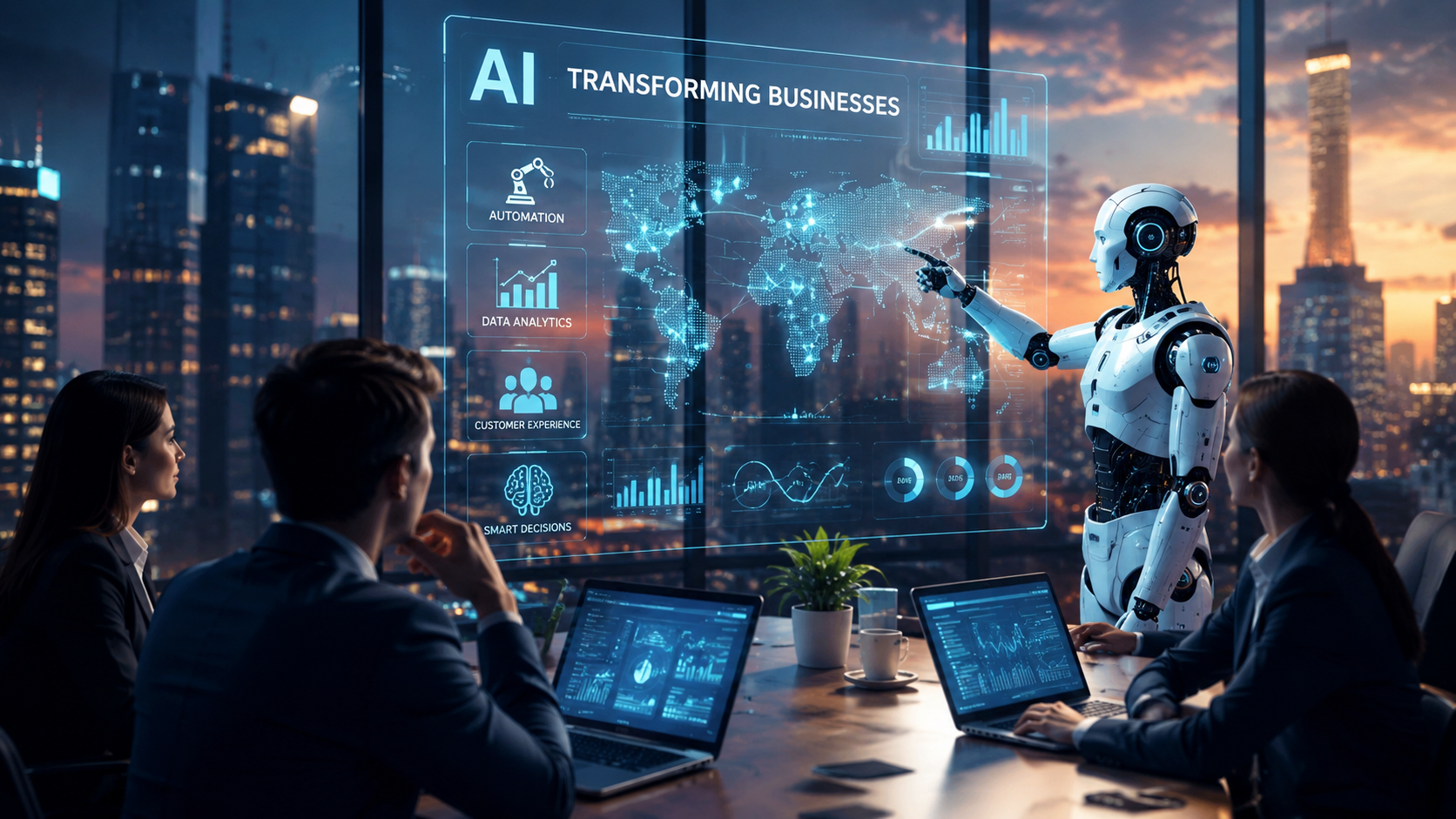
Walk into almost any office today, and you will find artificial intelligence quietly running in the background. It is scheduling meetings, answering customer queries, predicting sales trends, and even helping executives make decisions they once relied purely on gut instinct to make. This shift did not happen overnight, but it has happened faster than most business leaders expected.
How AI is transforming modern businesses worldwide is no longer a question reserved for tech conferences or research papers. It is a daily reality for companies of every size, from small local shops using chatbots to multinational corporations running entire supply chains on predictive algorithms. What makes this transformation so significant is not just the technology itself, but how deeply it is changing the way people work, think, and make decisions.
Businesses that once measured success in quarterly reports now measure it in real-time dashboards. Teams that once spent hours compiling data now spend those hours interpreting insights that AI has already generated for them. This article explores how AI is reshaping industries, the specific ways companies are using it, the challenges that come with adoption, and what the future might hold for businesses that embrace this change.
The Rise of AI in the Business World
A decade ago, artificial intelligence was mostly associated with science fiction or highly specialized research labs. Today, it sits inside everyday business tools that employees use without a second thought. Customer relationship management platforms now include AI-driven recommendations. Accounting software flags unusual transactions automatically. Even simple email tools suggest replies based on context.
This rise did not happen because AI suddenly became smarter overnight. It happened because computing power became cheaper, data became more abundant, and cloud infrastructure made powerful tools accessible to businesses that could never have afforded them before. A small retail company in a mid-sized city can now use the same kind of predictive analytics that only Fortune 500 companies could access fifteen years ago.
Business leaders have also become more comfortable with the idea of letting algorithms assist in decision-making. There was a time when relying on a machine to suggest a business strategy felt risky or even absurd. Now, ignoring what the data suggests feels riskier than trusting it.
Why This Shift Matters Now
The timing of this transformation is not accidental. Global competition has intensified, customer expectations have risen, and the margin for error in business decisions has shrunk. Companies need to move faster, understand their customers better, and cut unnecessary costs without sacrificing quality. AI offers a way to do all three at once, which is exactly why adoption has accelerated so quickly across so many sectors.
How AI Is Transforming Modern Businesses Worldwide Across Industries
The impact of AI is not limited to tech companies. It has spread into nearly every corner of the global economy, often in ways that are not immediately visible to the average consumer.
Retail and E-Commerce
Online shopping has been reshaped almost entirely by AI. Product recommendations, personalized email campaigns, and dynamic pricing models all rely on algorithms analyzing customer behavior in real time. When a shopper browses a website and sees “customers who bought this also bought,” that suggestion is powered by machine learning models trained on millions of purchasing patterns.
Inventory management has also improved dramatically. Retailers can now predict which products will sell well in specific regions during specific seasons, reducing waste and preventing stockouts. This level of precision was simply not possible when businesses relied on manual forecasting.
Healthcare and Pharmaceuticals
In healthcare, AI is helping doctors diagnose conditions earlier and more accurately by analyzing medical images and patient records at a speed no human team could match. Hospitals are using predictive models to anticipate patient admission rates, allowing better staffing and resource allocation. Pharmaceutical companies are using AI to shorten the drug discovery process, which traditionally took years, by simulating chemical interactions digitally before physical trials even begin.
Finance and Banking
Banks were among the earliest adopters of AI, largely because fraud detection and risk assessment are natural fits for machine learning. Algorithms can flag suspicious transactions within milliseconds, something that would take a human analyst hours to notice. Beyond fraud prevention, AI now powers robo-advisors that help everyday people manage investment portfolios without needing a personal financial advisor.
Manufacturing and Supply Chain
Factories around the world are integrating AI-powered sensors that predict when machinery is likely to fail, allowing maintenance teams to fix problems before they cause costly downtime. Supply chain managers use AI to reroute shipments in real time when disruptions occur, something that became especially valuable during global shipping delays in recent years.
Marketing and Customer Engagement
Marketing teams now rely heavily on AI to understand customer sentiment, optimize ad spending, and personalize content at scale. Instead of sending the same email to an entire customer list, businesses can tailor messages based on individual browsing history, purchase behavior, and even the time of day a customer is most likely to open an email.
The Core Ways AI Is Changing Business Operations
Beyond industry-specific applications, there are broader operational shifts happening inside companies of all types. These changes touch nearly every department, from human resources to finance to customer service.
Smarter Decision-Making
Perhaps the most significant change AI has brought to business is the shift from reactive decision-making to predictive decision-making. Instead of waiting for a problem to occur and then responding, companies can now anticipate issues before they arise. A retailer can predict a drop in demand before it happens. A manufacturer can predict equipment failure weeks in advance. This shift from reaction to prediction is fundamentally changing how businesses plan for the future.
Automation of Repetitive Tasks
Many jobs involve repetitive, time-consuming tasks that do not require creativity or emotional intelligence. Data entry, invoice processing, appointment scheduling, and basic customer inquiries are increasingly handled by AI systems. This does not necessarily mean fewer jobs overall, but it does mean employees are spending less time on mundane tasks and more time on work that requires human judgment, creativity, or relationship-building.
Enhanced Customer Experience
Customers today expect fast, personalized service, and AI has made it possible for businesses to deliver that at scale. Chatbots handle simple inquiries instantly, freeing human support agents to focus on complex issues. Recommendation engines make shopping feel more personal. Even something as simple as a well-timed follow-up email can now be generated automatically based on a customer’s specific behavior.
Cost Reduction and Efficiency Gains
Businesses that implement AI thoughtfully often see measurable cost savings. Automating routine processes reduces labor costs, predictive maintenance reduces equipment downtime, and better forecasting reduces wasted inventory. These savings can then be reinvested into innovation, employee development, or customer experience improvements.
Real-World Examples of AI Adoption
It helps to look at concrete examples rather than abstract concepts. A logistics company might use AI to optimize delivery routes, saving fuel costs and reducing delivery times simultaneously. A small accounting firm might use AI-powered software to automatically categorize expenses, cutting down the hours previously spent on manual bookkeeping.
Consider a mid-sized clothing brand that integrated AI into its customer service operations. Before AI, the company relied on a small support team that struggled to keep up with customer inquiries during sales events. After implementing an AI chatbot trained on common customer questions, response times dropped significantly, and the human team was able to focus on more complex complaints that required empathy and nuanced problem-solving.
Similarly, a regional bank introduced AI-driven fraud detection and saw a noticeable reduction in fraudulent transactions within the first few months. The system learned patterns of legitimate customer behavior and flagged anomalies almost instantly, something the previous rule-based system had struggled to do effectively.
These examples show that AI adoption does not require massive budgets or enterprise-level resources. Even smaller businesses can benefit from targeted AI implementation in specific areas of their operations.
Challenges Businesses Face When Adopting AI
Despite its benefits, AI adoption is not without obstacles. Understanding these challenges is just as important as understanding the benefits, especially for business leaders considering their own AI strategy.
One of the biggest hurdles is data quality. AI systems are only as good as the data they are trained on. A business with incomplete, outdated, or inconsistent data will struggle to get meaningful results from AI tools, no matter how advanced those tools are. Cleaning and organizing data often takes far longer than businesses initially expect.
Another challenge is employee resistance. Not every team member welcomes automation with open arms. Some employees worry about job security, while others simply feel overwhelmed by the learning curve associated with new technology. Successful AI adoption usually requires clear communication about how the technology will support employees rather than replace them, along with proper training to help teams feel confident using new tools.
Cost is also a factor, particularly for smaller businesses. While many AI tools have become more affordable, implementing a comprehensive AI strategy still requires investment in software, infrastructure, and sometimes specialized staff. Businesses need to carefully evaluate which areas of their operations will benefit most from AI before committing significant resources.
Finally, there are ethical and regulatory considerations. As AI becomes more involved in decision-making, businesses must ensure their systems are fair, transparent, and compliant with data privacy regulations. This is especially important in industries like healthcare and finance, where decisions made by AI can have serious consequences for individuals.
The Human Side of AI Transformation
It is easy to focus purely on efficiency gains and cost savings, but the human side of this transformation deserves attention too. Employees who once spent their days on repetitive tasks are now being asked to develop new skills, think more strategically, and engage with technology in ways they may not have anticipated when they started their careers.
This shift can be uncomfortable, but it also opens doors. Customer service representatives who once answered the same questions repeatedly now have the opportunity to build deeper relationships with customers on more complex issues. Analysts who once spent hours compiling reports now spend that time interpreting results and advising leadership on strategy.
Business leaders who approach AI adoption with empathy, rather than simply viewing it as a cost-cutting measure, tend to see better long-term results. Employees who feel supported through technological change are more likely to embrace new tools and contribute ideas about how those tools can be used more effectively.
What the Future Holds for AI in Business
Looking ahead, the role of AI in business is only expected to grow. Generative AI tools are already helping companies create content, design products, and even write code. As these tools become more sophisticated, the line between human and AI-generated work will continue to blur, requiring businesses to think carefully about how they balance automation with authenticity.
Small and medium-sized businesses are likely to see the biggest relative gains in the coming years, simply because AI tools are becoming more affordable and easier to implement without requiring a dedicated technical team. This democratization of AI means that competitive advantages once reserved for large corporations will become accessible to businesses of nearly any size.
At the same time, businesses that fail to adapt risk falling behind competitors who are already using AI to move faster, serve customers better, and operate more efficiently. This does not mean every business needs to adopt every AI tool available, but it does mean ignoring the trend entirely is becoming a riskier strategy with each passing year.
There are two practical steps most businesses should consider as they plan their AI strategy:
- Start with a specific, measurable problem, such as slow customer response times or inaccurate inventory forecasting, rather than trying to implement AI across the entire organization at once.
- Invest in employee training alongside the technology itself, since tools are only effective when the people using them understand how to interpret and act on the insights AI provides.
Frequently Asked Questions
How is AI transforming modern businesses worldwide?
AI is helping businesses automate repetitive tasks, improve decision-making through predictive analytics, and deliver more personalized customer experiences across nearly every industry.
Is AI adoption only beneficial for large corporations?
No, small and medium-sized businesses are increasingly able to access affordable AI tools that improve efficiency and customer engagement without requiring massive budgets.
What industries are most affected by AI?
Retail, healthcare, finance, manufacturing, and marketing are among the industries experiencing the most significant AI-driven transformation.
Will AI replace human jobs entirely?
AI tends to automate repetitive tasks rather than eliminate jobs entirely, often allowing employees to focus on more strategic, creative, or relationship-based work.
What is the biggest challenge businesses face when adopting AI?
Poor data quality is one of the most common challenges, since AI systems rely heavily on clean, accurate, and well-organized data to function effectively.
How can a small business start using AI?
Small businesses can start by identifying one specific problem, such as slow customer response times, and implementing a targeted AI tool to address that issue before expanding further.
Is AI adoption expensive for businesses?
Costs vary widely depending on the tools and scale of implementation, but many AI solutions have become more affordable, making adoption accessible even for smaller companies.
Conclusion
How AI is transforming modern businesses worldwide is a story that continues to unfold in real time. From retail to healthcare to finance, artificial intelligence is no longer a futuristic concept but a practical tool reshaping how companies operate, compete, and grow. Businesses that embrace AI thoughtfully, addressing challenges like data quality and employee adaptation along the way, are positioning themselves for long-term success in an increasingly competitive global market.