

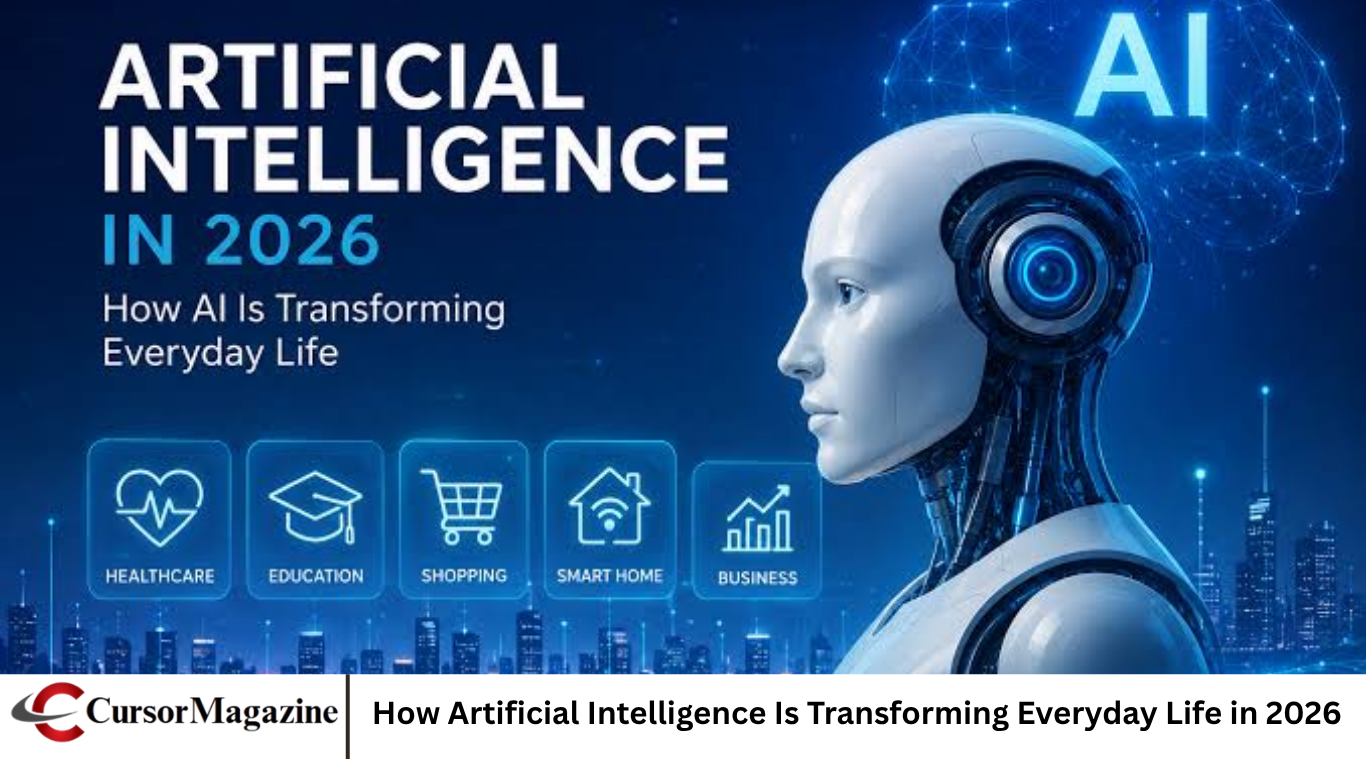
Artificial intelligence has moved from being a futuristic idea to becoming a practical part of everyday life. Many people use AI without even realizing it. From smartphone assistants and personalized recommendations to navigation apps, online shopping, smart home devices, and workplace software, artificial intelligence is quietly influencing how people complete everyday tasks.
In 2026, the role of AI is becoming even broader. New systems can understand natural language, analyze information, generate content, recognize patterns, and assist with complicated tasks. While AI offers many benefits, it also creates questions about privacy, employment, accuracy, and responsible use. Understanding these changes can help people make better decisions about the technology they use every day.
What Is Artificial Intelligence?
Artificial intelligence refers to computer systems designed to perform tasks that normally require some form of human intelligence. These tasks can include understanding language, recognizing images, analyzing information, identifying patterns, making predictions, and generating content.
Modern AI systems are powered by large amounts of data and sophisticated algorithms. Machine learning allows systems to improve their performance by identifying patterns in information, while generative AI can create text, images, audio, video, and other forms of content.
The technology is now being integrated into many products and services that people use regularly.
AI in Smartphones
Smartphones are among the most common places where people encounter artificial intelligence. Modern phones use AI for photography, voice recognition, translation, security, personalization, and battery management.
AI-powered camera systems can automatically identify scenes and adjust settings to improve photos. Facial recognition and other biometric technologies can help protect devices, while voice assistants allow users to interact with phones using natural language.
Some smartphones can also summarize notifications, edit images, organize information, and provide intelligent suggestions.
AI-Powered Search
Search engines are changing as artificial intelligence becomes more advanced. Instead of simply displaying a list of websites, modern search experiences can provide summaries, explanations, comparisons, and direct answers.
AI can understand the context behind a question and help users find relevant information more efficiently.
However, users should still verify important information because AI-generated answers can sometimes contain inaccurate or incomplete details.
AI in Online Shopping
Artificial intelligence has significantly changed online shopping. E-commerce platforms use AI to recommend products based on browsing behavior, previous purchases, searches, and other signals.
AI can also help customers find products by analyzing natural-language descriptions. Instead of searching with exact product names, users can describe what they need and receive relevant suggestions.
Behind the scenes, AI can also help businesses manage inventory, detect unusual transactions, and improve customer service.
AI in Entertainment
Entertainment platforms use artificial intelligence to personalize what users see and hear. Streaming services can analyze viewing or listening habits and recommend movies, shows, music, podcasts, and other content.
AI can also assist creators with editing, visual effects, music production, writing, and other creative processes.
This does not necessarily replace human creativity. Instead, AI can provide additional tools that help creators experiment with ideas and complete repetitive tasks more efficiently.
AI in Education
Education is another area experiencing major changes because of artificial intelligence. Students can use AI tools to explain difficult concepts, summarize information, practice languages, generate study questions, and receive feedback on their work.
Teachers can also use AI to create lesson materials, organize information, and develop educational activities.
However, responsible use is important. Students should use AI as a learning aid rather than depending on it to complete all of their academic work.
AI and Healthcare
Artificial intelligence is increasingly being used in healthcare-related applications. AI can help analyze medical images, identify patterns in health data, assist researchers, and support administrative tasks.
Wearable devices can also use algorithms to analyze information such as activity, heart rate, and sleep patterns.
AI does not replace qualified healthcare professionals. Medical decisions require professional judgment, clinical evidence, and appropriate evaluation.
AI in Transportation
Transportation is another area where artificial intelligence is becoming increasingly important. Navigation applications use algorithms to analyze traffic information and recommend routes.
Modern vehicles can also use AI-powered driver assistance systems to detect surrounding objects, maintain lanes, monitor blind spots, and provide warnings.
Fully autonomous transportation remains a developing field, but AI is already contributing to safer and more efficient driving technologies.
AI in the Workplace
Artificial intelligence is changing how many people work. Employees can use AI tools to draft documents, summarize meetings, analyze data, organize schedules, create presentations, and automate repetitive tasks.
AI can save time by handling routine work, allowing employees to focus more attention on creative thinking, decision-making, and communication.
At the same time, businesses need to train employees to use AI responsibly and verify important outputs.
AI and Communication
AI is making communication easier across languages and platforms. Translation tools can convert text and speech between languages, helping people communicate with individuals from different parts of the world.
AI can also help users improve grammar, rewrite messages, summarize long conversations, and create professional documents.
These capabilities can make communication faster while reducing language barriers.
AI in Smart Homes
Smart home technology is becoming more intelligent through artificial intelligence. Smart speakers, cameras, thermostats, lighting systems, and appliances can use AI to understand patterns and respond to user preferences.
For example, a smart home system may adjust temperature settings according to schedules or provide alerts when unusual activity is detected.
As connected devices become more sophisticated, AI could make homes increasingly automated.
AI and Personal Productivity
AI can act as a digital assistant for many everyday activities. People can use AI to organize information, create reminders, summarize documents, plan projects, brainstorm ideas, and manage repetitive tasks.
This can be especially useful for people who deal with large amounts of information.
Instead of replacing human decision-making, AI works best as a tool that helps people process information and complete routine activities more efficiently.
AI in Finance
Financial institutions use artificial intelligence for fraud detection, risk analysis, customer support, and transaction monitoring.
Consumers may encounter AI when receiving automated financial recommendations, fraud alerts, or personalized services.
AI can analyze large amounts of financial information much faster than traditional manual methods, but financial decisions still require careful consideration and appropriate human oversight.
AI and Cybersecurity
As cyber threats become more sophisticated, artificial intelligence is being used to identify suspicious activity and detect potential security problems.
AI systems can analyze large amounts of network data and recognize unusual patterns that may indicate malicious activity.
However, attackers can also use AI to create more sophisticated threats. This means cybersecurity will continue to be an ongoing competition between defensive and offensive technologies.
AI in Content Creation
Generative artificial intelligence has transformed content creation. Users can create drafts, images, presentations, audio, and other digital materials with AI-assisted tools.
For writers, designers, marketers, and creators, these systems can reduce the time required for initial drafts and repetitive tasks.
Human review remains important because AI-generated content may contain errors, outdated information, or material that does not match the intended audience.
AI and Employment
One of the biggest concerns surrounding artificial intelligence is its effect on employment. AI can automate certain repetitive tasks, which may change the responsibilities associated with some jobs.
At the same time, new roles are emerging around AI development, management, data analysis, cybersecurity, and responsible technology use.
The future of work is likely to involve greater cooperation between people and AI rather than a simple replacement of humans.
Privacy Concerns
The increasing use of AI also raises privacy concerns. Many AI-powered services depend on large amounts of information to provide personalized experiences.
Users should understand what data applications collect, how that information is used, and what privacy controls are available.
Reviewing privacy settings and limiting unnecessary permissions can help users maintain greater control over their personal information.
The Problem of AI Accuracy
Artificial intelligence can be powerful, but it is not always correct. AI systems can produce incorrect information, misunderstand questions, or provide answers that sound convincing but are inaccurate.
This is especially important when dealing with health, finance, legal matters, education, or other areas where mistakes can have serious consequences.
Users should verify important information through reliable sources before acting on AI-generated answers.
AI and Human Creativity
There is ongoing discussion about whether artificial intelligence can replace human creativity. AI can generate impressive text, images, music, and other content, but human creativity involves personal experience, emotion, cultural understanding, judgment, and original perspective.
AI is often most useful when it supports human creativity rather than completely replacing it.
People can use AI to brainstorm ideas, explore possibilities, and speed up repetitive parts of the creative process while retaining control over the final result.
How AI Could Develop Further
Artificial intelligence is likely to become even more integrated into everyday devices and services. Future systems may become better at understanding context, handling multiple types of information, and completing tasks across different applications.
AI assistants could become more capable of managing schedules, communications, shopping, travel planning, and other activities.
The challenge will be ensuring that these systems remain secure, transparent, accurate, and respectful of user privacy.
How to Use AI Responsibly
Using artificial intelligence responsibly requires understanding both its benefits and limitations. Users should avoid sharing sensitive personal information unnecessarily and should verify important information before relying on it.
AI-generated content should also be reviewed before being published or used for important decisions.
The best approach is to treat AI as a powerful assistant rather than an unquestionable authority.
Conclusion
Artificial intelligence is transforming everyday life in 2026 by changing how people communicate, work, learn, shop, travel, create content, manage their homes, and access information. Its growing capabilities provide significant opportunities to save time and improve productivity, but they also introduce challenges involving privacy, accuracy, security, and employment.
The most useful approach is to embrace AI while maintaining human judgment and carefully checking important information. As the technology continues to develop, artificial intelligence will likely become an even more familiar part of everyday life, making digital experiences increasingly personalized, automated, and intelligent.
Frequently Asked Questions
What is artificial intelligence?
Artificial intelligence is technology that enables computer systems to perform tasks that normally require human intelligence, such as understanding language, recognizing patterns, analyzing information, and generating content.
How is AI changing everyday life?
AI is changing everyday life through smart assistants, personalized recommendations, navigation, online shopping, healthcare tools, education platforms, smart home devices, and workplace software.
Is artificial intelligence useful for students?
Yes. AI can help students understand difficult concepts, summarize information, practice languages, generate study questions, and organize learning materials. Students should still verify information and use AI responsibly.
How is AI changing the workplace?
AI can automate repetitive tasks, summarize information, analyze data, create drafts, and assist with communication. This can allow workers to spend more time on creative and decision-making activities.
Does AI create privacy concerns?
Yes. Some AI-powered services collect and process user information. Users should review privacy settings, understand data policies, and avoid sharing sensitive information unnecessarily.
Can artificial intelligence replace human creativity?
AI can assist with writing, images, music, and other creative tasks, but human judgment, experience, emotion, and originality remain important parts of the creative process.
Is AI always accurate?
No. AI can sometimes produce incorrect or incomplete information. Important information should always be checked against reliable sources before making decisions.
What can we expect from AI in the future?
AI is expected to become more integrated into smartphones, computers, vehicles, smart homes, workplaces, and other everyday technologies, with greater automation and personalization.