

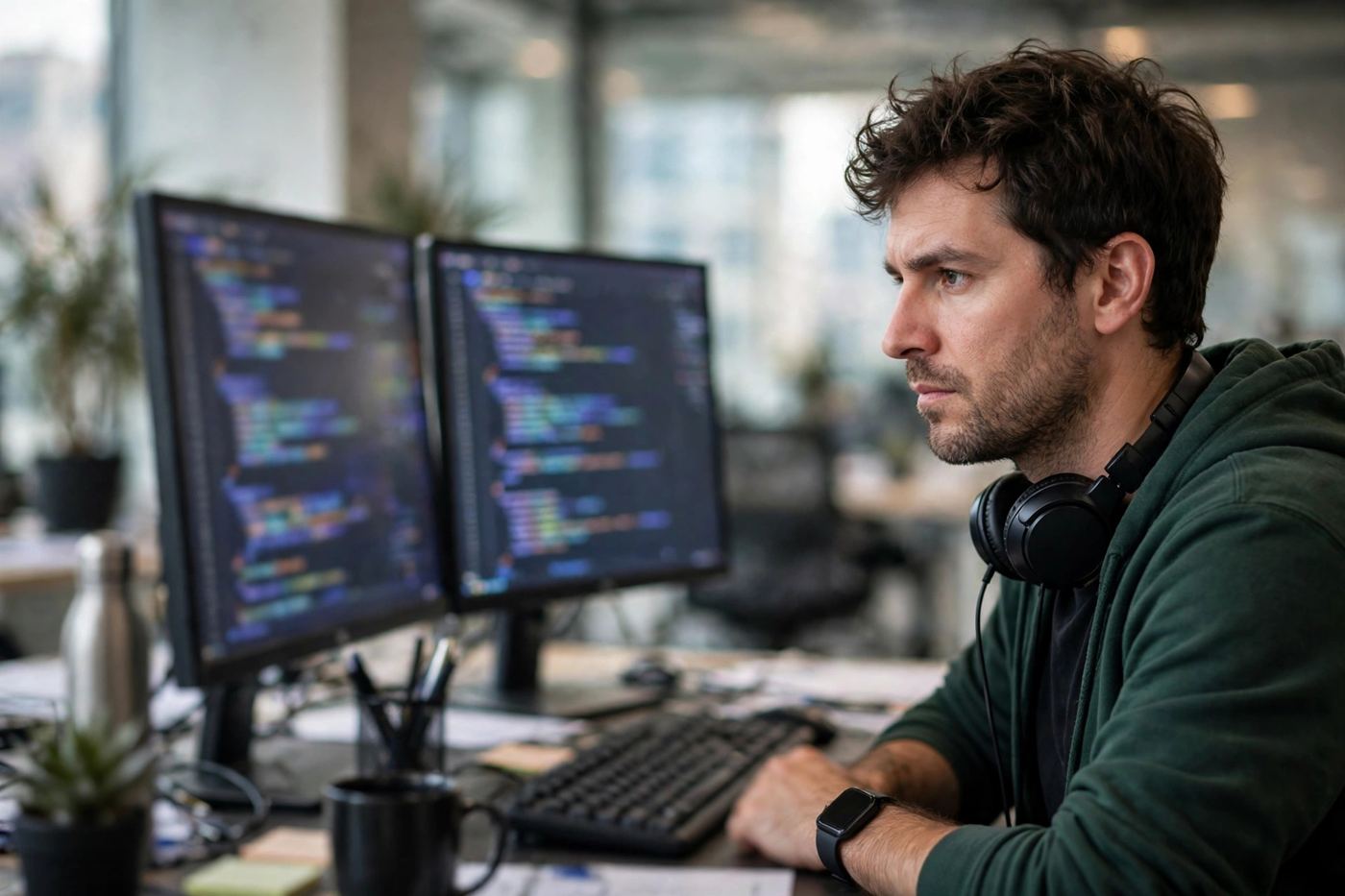
The code editor used to be the most conservative software on a programmer’s machine: syntax highlighting, autocomplete of the dumb and loyal kind, and a blinking cursor that waited for instructions. The AI-native editor inverted the relationship. It suggests whole functions, refactors across files, explains unfamiliar codebases in plain language, and increasingly acts on instructions given in prose. For a growing share of working programmers, it has simply become the editor, the way the previous generation’s tool became invisible through familiarity.
What changed was not a single feature but the accumulation of context. An assistant that can see the whole repository, the error trace and the test suite stops being a fancy autocomplete and becomes something closer to a tireless junior collaborator: fast, confident, occasionally wrong in interesting ways. We have followed this tooling shift in our technology coverage as it moved from demo videos to the default installation on engineering laptops.
The workflow that actually emerged
Veteran users describe a rhythm quite different from the marketing. The human sketches architecture and writes the critical paths; the assistant drafts the connective tissue, generates the tests, and performs the mechanical refactor at 2 a.m. energy levels. Code review, already the discipline’s quality gate, has become the central skill, because the volume of plausible code a team can now produce exceeds the volume it can casually verify.
The editor as environment
The deeper change is that the editor has stopped being a tool and become an environment. Source control, terminal, documentation, tickets and now the assistant live in one surface, and the programmer’s attention, once spent switching between them, is being reallocated to the problem itself. Toolmakers compete on the quality of that attention: whose assistant asks before it edits, shows its reasoning, and knows when a suggestion should wait.
There is a generational texture to the adoption curve. Programmers who began with the AI editor experience its absence as a disability; veterans experience its presence as a negotiation. Both are describing the same fact: the baseline of the craft moved, and the profession is, characteristically, arguing about it in the commit messages.
The costs under the productivity
Engineering leaders are cataloguing the shadows: subtle bugs introduced at scale, codebases swelling with code nobody fully owns, security review stretched thin, and juniors whose learning curve we discussed across the industry press this year. The IEEE has hosted much of the serious debate, and its tone is neither utopian nor dismissive: the tool is a genuine capability jump, and like all such jumps it punishes teams that adopt it without adapting their process.
The cursor still blinks. But it now blinks inside a conversation, and programming will not be going back to silence.
