

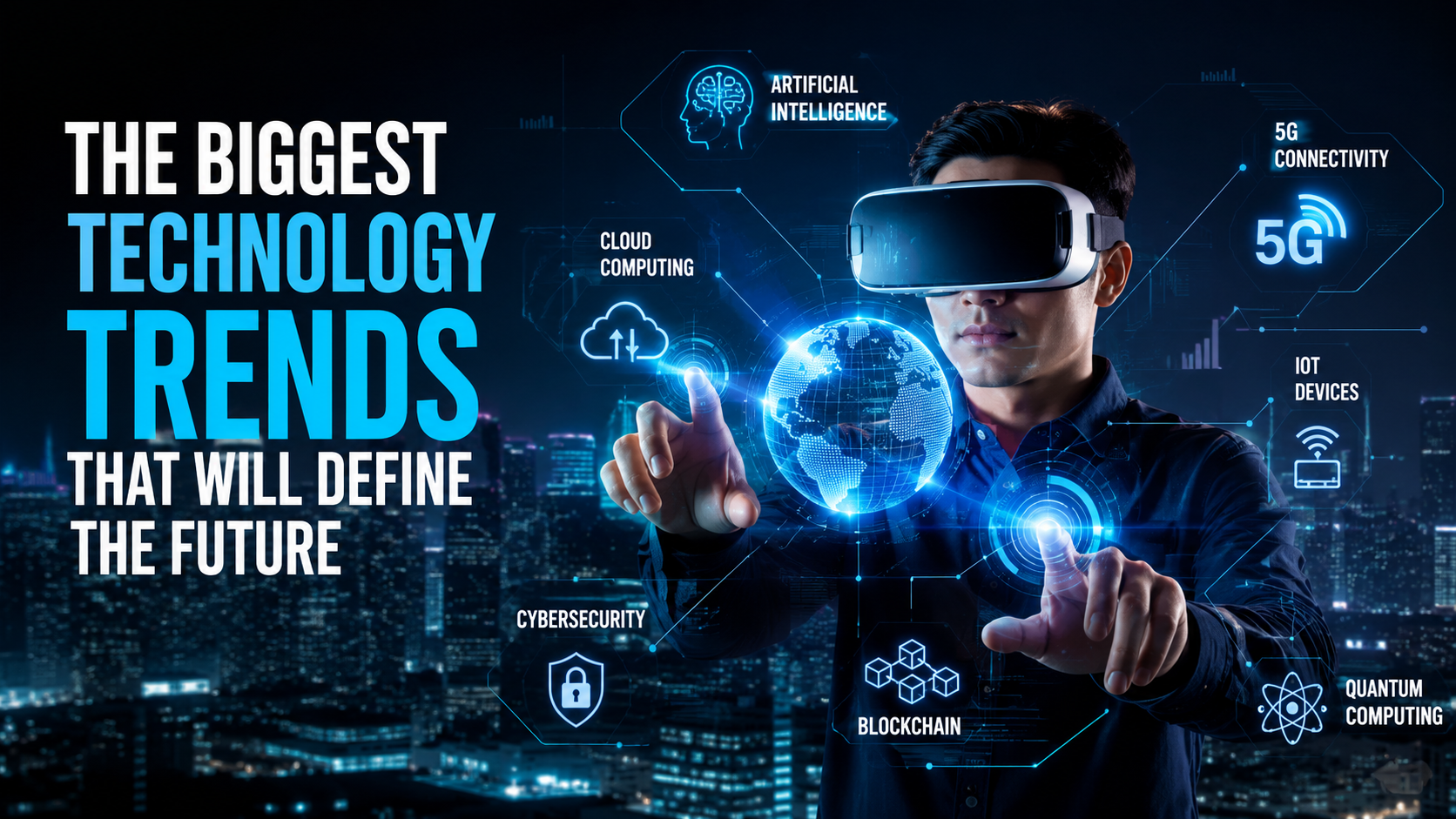
Technology no longer moves at a predictable pace. It leaps. One year we’re marveling at chatbots that can hold a conversation, and the next we’re watching machines diagnose diseases, drive cars through city traffic, and write functioning software code. If you’ve felt like the world is changing faster than you can keep up with, you’re not imagining it.
Understanding the biggest technology trends isn’t just for engineers or Silicon Valley insiders anymore. Whether you’re a business owner, a student, or simply someone curious about what’s coming next, these shifts will touch your daily life in ways both obvious and subtle. From how we work to how we shop, heal, and connect with one another, technology is quietly rewriting the rules.
1. Artificial Intelligence Is Becoming the New Electricity
It’s hard to talk about technology trends without starting with artificial intelligence. AI has moved from being a niche research topic to something embedded in nearly every industry. It powers recommendation engines, customer service bots, medical imaging tools, and even creative software that helps writers and designers brainstorm ideas.
What makes this moment different from previous AI hype cycles is accessibility. A decade ago, building an AI model required a research lab and a small fortune. Today, a small business owner can integrate AI tools into their workflow within an afternoon, often for free or a modest subscription fee.
Generative AI and the Creative Shift
Generative AI deserves special attention because of how quickly it has changed creative and professional work. Tools that generate text, images, music, and even video are no longer experimental toys—they’re becoming standard parts of marketing teams, design studios, and software development pipelines. This doesn’t mean human creativity is being replaced. Instead, it’s being amplified, with professionals using AI as a collaborator rather than a competitor.
The Push Toward Responsible AI
As AI becomes more powerful, the conversation around ethics and regulation is growing louder. Governments and organizations are working to establish guardrails around data privacy, bias, and transparency. This trend toward responsible AI development will likely shape how companies build and deploy these systems for years to come.
2. The Rise of Quantum Computing
While AI dominates headlines, quantum computing is quietly working in the background, promising to solve problems that traditional computers simply cannot handle. Instead of processing information in binary bits, quantum computers use qubits, which can exist in multiple states simultaneously.
This might sound abstract, but the implications are massive. Industries like pharmaceuticals, finance, and materials science could use quantum computing to simulate molecular interactions, optimize complex financial models, or design new materials at speeds unimaginable with today’s technology.
We’re still in the early innings here. Widespread commercial quantum computing is likely years away, but the groundwork being laid today by major tech companies and research institutions suggests this trend will only accelerate. Businesses that start exploring quantum readiness now may find themselves with a significant competitive edge later.
3. Extended Reality Is Reshaping How We Interact With Digital Spaces
Extended reality, which includes virtual reality, augmented reality, and mixed reality, is steadily moving from gaming novelty to practical tool. Retailers are using augmented reality to let customers virtually try on clothes or preview furniture in their homes. Surgeons are training using virtual simulations that mimic real operating conditions without any risk to patients.
The workplace is also being transformed by this trend. Remote teams are experimenting with virtual meeting spaces that feel more immersive than a standard video call, allowing colleagues to collaborate on 3D models or walk through virtual prototypes together, regardless of where they’re physically located.
As headsets become lighter, more affordable, and more comfortable, extended reality is likely to become a normal part of both entertainment and professional life rather than a specialized gadget reserved for early adopters.
4. The Internet of Things Continues to Expand Quietly
The Internet of Things, often shortened to IoT, refers to the growing network of everyday devices connected to the internet, from smart thermostats to industrial sensors. This trend has been building for years, but its scale is becoming more apparent as more devices come online.
In homes, this means smarter energy management, security systems that respond in real time, and appliances that learn our habits. In industrial settings, IoT sensors are helping manufacturers predict equipment failures before they happen, saving companies significant time and money.
Cities are getting smarter too. Traffic lights that adjust based on real-time congestion, waste management systems that optimize collection routes, and energy grids that balance supply and demand more efficiently are all examples of IoT working behind the scenes to make urban life more efficient.
5. Cybersecurity Becomes a Boardroom Priority
As more of our lives and businesses move online, the stakes for cybersecurity have never been higher. This isn’t a new trend, but it’s evolving rapidly in response to increasingly sophisticated threats. Ransomware attacks, data breaches, and phishing schemes have pushed cybersecurity from an IT department concern to a top priority discussed in company boardrooms.
Zero trust security models, which assume no user or device should be automatically trusted, are becoming the standard approach for organizations serious about protecting their data. At the same time, AI is playing a dual role in this space, both as a tool that helps detect threats faster and as a resource that malicious actors are learning to exploit.
For everyday users, this trend translates into more emphasis on multi-factor authentication, biometric security, and greater awareness around digital hygiene. As our digital footprint grows, protecting it will remain one of the defining challenges of the coming decade.
Here are a few of the technologies driving this shift in cybersecurity:
- AI-powered threat detection systems that identify unusual patterns in real time
- Biometric authentication methods like fingerprint and facial recognition
- Zero trust architecture that verifies every access request
6. Sustainable Technology and Green Innovation
Climate concerns are pushing sustainability to the forefront of technological development. This trend spans everything from renewable energy storage to more efficient data centers designed to reduce the environmental impact of our increasingly digital world.
Electric vehicles have moved from niche products to mainstream options, supported by rapidly improving battery technology and expanding charging infrastructure. Meanwhile, tech companies are investing heavily in carbon capture research, sustainable materials, and energy-efficient computing to reduce their environmental footprint.
This shift isn’t purely altruistic. Consumers increasingly favor companies with strong sustainability practices, and regulations around emissions and energy use are tightening globally. As a result, green innovation has become both an ethical imperative and a smart business strategy.
7. Automation and the Future of Work
Automation continues to reshape industries, from manufacturing floors to office environments. Robotic process automation handles repetitive administrative tasks, while advanced robotics are taking on more complex physical work in warehouses and factories.
This doesn’t necessarily mean widespread job loss, though it does mean significant job transformation. Many roles are shifting to focus more on oversight, creativity, and problem-solving, while routine tasks get handled by machines. Workers who develop skills in managing and collaborating with automated systems will likely find themselves well-positioned in this changing landscape.
Companies are also rethinking how they structure teams, blending human expertise with automated efficiency to create workflows that are faster and less prone to error. This trend will likely accelerate as automation technology becomes more sophisticated and accessible to smaller businesses, not just large corporations.
8. The Continued Evolution of 5G and Beyond
Faster, more reliable connectivity underpins nearly every other trend on this list. 5G networks have enabled everything from smoother streaming to real-time data processing for autonomous vehicles and remote surgery. As adoption continues to expand globally, we’re already seeing early research into what comes next.
This next generation of connectivity promises even lower latency and higher capacity, which will be essential as more devices, vehicles, and systems rely on instant data exchange. For industries like healthcare, transportation, and manufacturing, this improved connectivity isn’t just a convenience. It’s becoming a foundational requirement for innovation.
Why These Technology Trends Matter for Everyone
It’s tempting to think of these developments as distant or abstract, but their impact is already visible in daily life. The way we shop, work, communicate, and even receive medical care is being reshaped by the technologies described above. Businesses that adapt early tend to gain a meaningful advantage, while individuals who stay informed are better equipped to navigate a rapidly changing job market and digital landscape.
What’s especially notable about this current wave of technology trends is how interconnected they are. Artificial intelligence powers better cybersecurity tools. Faster connectivity supports more immersive extended reality experiences. IoT devices generate the data that AI systems use to make smarter decisions. Rather than developing in isolation, these trends are reinforcing one another, creating a feedback loop of innovation that’s accelerating faster than most people anticipated.
Staying curious and adaptable is perhaps the best strategy for anyone hoping to thrive amid this pace of change. You don’t need to become a technical expert overnight, but understanding the broad strokes of where technology is heading can help you make better decisions, whether that’s choosing a career path, running a business, or simply deciding what tools are worth your time.
Frequently Asked Question
What is the biggest technology trend right now?
Artificial intelligence, particularly generative AI, is widely considered the most influential trend today due to its rapid adoption across nearly every industry.
Will automation eliminate jobs?
Automation will change many jobs rather than eliminate them entirely, shifting human focus toward oversight, creativity, and tasks that require judgment.
Is quantum computing available for everyday use?
Not yet. Quantum computing is still primarily in research and early commercial stages, with widespread practical use likely years away.
How does 5G impact everyday life?
5G enables faster internet speeds and lower latency, improving everything from video streaming to real-time applications like connected vehicles and remote healthcare.
What is extended reality used for?
Extended reality combines virtual, augmented, and mixed reality to support gaming, retail experiences, medical training, and immersive remote collaboration.
Why is cybersecurity becoming more important?
As more business and personal activity moves online, the risk and sophistication of cyber threats have grown, making strong security practices essential.
How can businesses keep up with these technology trends?
Businesses can stay competitive by monitoring industry developments, investing in employee training, and gradually integrating relevant technologies rather than waiting until they become unavoidable.
Conclusion
The future of technology isn’t a single breakthrough waiting to happen. It’s a collection of interconnected trends, from artificial intelligence and quantum computing to sustainable innovation and smarter connectivity, all evolving together and reshaping the world in real time. These changes won’t wait for anyone to catch up, but they also don’t require panic. What they call for is curiosity, adaptability, and a willingness to learn as things unfold.